
By Mara Freilich, JD — former civil litigator, University of Pennsylvania Law School graduate, and law school admissions consultant. About page · State Bar profile · LinkedIn
You’ve studied for the LSAT. You’ve agonized over your personal statement. And then there’s the resume: a blank document, a nagging worry that your waitressing job doesn’t “count,” and no real idea what admissions officers actually want to see.
Sound familiar?
You’re in the right place, because today, I’ll share exactly how I’ve helped 300+ law school applicants apply to law school and write resumes.
In this guide:
- Does a law school resume matter?
- Law school resume vs. job resume
- What should a law school resume look like?
- How long should a law school resume be?
- How to write each section
- Can I use AI to write my resume?
- Law school resume examples
- Skills and interests
- For non-traditional applicants
- Common mistakes
- Build the rest of your application
Does a law school resume matter?
Yes, your resume is the starting point of your application. When I send a client’s resume back with a million-one edits (only slightly exaggerating), I’m often asked, “Does my resume even matter for law school?”
Fair question. You’ve probably talked about your activities and work experience in your essays already. So what’s the point of the resume? Why do law schools still ask for one?
In my experience, the resume is often where admissions officers start reading your application. It’s the seed for the positioning and narrative that everything else in your application grows from. In my opinion, it’s one of the most underused assets in the whole application.
Here’s why it matters:
- It shows how you’ve spent your time. Your resume tells law schools how you’ve spent your time, what your qualifications are, and what kinds of interests you’ve developed.
- It protects your personal statement. A resume that already carries your responsibilities and skills frees your essay to do something more interesting than list what you’ve done. Without one, you risk the biggest personal statement mistake: writing a glorified cover letter. (Want to avoid that? Here’s how to write a law school personal statement.)
- It’s evidence, not a list of activities. Admissions officers aren’t looking for the applicant who packed in the most activities or held the fanciest titles. They read each entry as evidence of how you operate, how you handle responsibility, and whether people trust you; if you are a good candidate for their law school.
How you structure your resume, what you include, and how you describe your experiences are strategic decisions in crafting your personal narrative. A well-written resume highlights what law schools look for: analytical and writing ability, leadership, work ethic, community engagement, language skills, and the ability to juggle multiple responsibilities (yes, including paying your own way through school).
So yes, your resume matters. Now let’s look at how it differs from the resume you’d send an employer.
Law school resume vs. job resume
A law school resume is written for an admissions committee, not an employer. You’re persuading an admissions committee that you’re the applicant they want. And law schools want to see a broader, more diverse array of experiences than any single job would ask for.
So there’s a big difference between a law school resume and any other resume. Here’s how they compare:
| Job resume | Law school resume | |
| Reader | A hiring manager | An admissions committee |
| Goal | Show you fit one specific role | Show how you’ve spent your time and handled responsibility |
| Objective or summary | Common | Skip it |
| What comes first | Usually your most recent experience | Education |
| Describing a job | Often the employer’s industry or results | What you did: your tasks and scope |
| Hours per week | Rarely listed | Include them for jobs held during school |
| High school | Not relevant | Leave it off (with rare exceptions) |
| Interests | Often skipped | Specific, memorable interests welcome |
| Language | Industry jargon is fine | Plain language any admissions officer can follow |
The common thread: an employer wants to know whether you fit a role. An admissions officer wants evidence of how you handle responsibility.
Law school resume vs. CV
A CV is a different document. For law school, you want a resume, with one exception: if you have a series of publications, you can list them separately, CV-style, even if that means your resume runs onto a third page (more on that in the length section below).
What should a law school resume look like?
Short answer: include education first, then experience, activities, community engagement, publications or accomplishments, and skills and interests. Use 11 pt font or larger, normal margins, and reverse chronological order within each section. Skip the objective, the summary, and relevant coursework.
Your resume is an undervalued, strategic part of your application. How you frame your experiences and organize the page should serve the broader theme you’ve built for your entire application.
In fact, I spend a lot of time with clients figuring out how to frame their resumes strategically. If a client wants to go into legal academia, for instance, we organize and describe their experiences to highlight the traits and skills that path requires.
Section order
Depending on your background, your resume will generally contain some combination of these headers, in this order:
- Education
- Professional Experience and/or Employment
- Activities
- Community Engagement
- Publications
- Accomplishments
- Skills/Interests
Why education first? Unlike other fields or jobs, law schools (and law in general) care a lot about your education.
Formatting rules
- Font size: 11 pt or larger.
- Margins: normal. You can narrow them slightly, but only if you have to. Try to be more concise in your descriptions instead.
- Skip these sections: an Objective, a Summary of Qualifications, and Relevant Coursework. They belong on job-hunt resumes, not law school resumes.
- Order: reverse chronological within each section. Don’t switch to a skills-first (functional) format, because admissions officers want to see how you spent your time.
Group by theme when it helps
You don’t have to stick with strict chronology across your whole resume. You can get creative with how you group experiences.
I had a client with two very involved passion areas: education and gender violence. Instead of listing everything by date, we made two separate headers, “Education” and “Gender Violence,” and put her activities in chronological order within each one. It showed her focus and well-built passion, instead of making it look like she had scattered interests.
A plain-text skeleton you can copy
Here’s the layout in its simplest form. Replace the brackets with your own details and delete any section you don’t need.
[YOUR NAME]
[City, State] | [Email] | [Phone]
Education
- GPA: [only if near or above the law school’s median]
- Honors: [magna cum laude, thesis title, Dean’s List semesters, honor societies, scholarships/awards]
Professional Experience
- [Action verb] + what you did + scope
- [Action verb] + what you did + scope
Activities
- [What you were responsible for]
Community Engagement
- [What you did and how often]
Publications
[Citation, with a one-line description if the title isn’t obvious]
Skills & Interests
Languages: [Language (level of proficiency)]
Interests: [specific, memorable interests]
How long should a law school resume be?
Short answer: one or two pages. Law schools don’t really care about the length, as long as you’re not using a tiny font to squeeze onto one page or adding unnecessary details to fill a second.
A two-page resume is not necessarily better than a one-page resume, and vice versa. It depends on what you have to say:
- Recently out of undergrad with a lot to include? A two-page resume is fine.
- At the same job for the past decade? Just because you’ve been out of school a while doesn’t mean you need two pages. One is fine.
- A series of publications? This is the one time I say it’s okay to spill onto a third page. List them separately like you would on a resume.
Some schools also state their own length guidance, so check each school’s instructions before you finalize.
What should you cut if everything doesn’t fit on 1-2 pages?
Too much to fit? Don’t shrink the font. Cut in this order:
1. Cut these completely
- High school activities and honors. Law schools are evaluating professional maturity and don’t care what you did in high school. Unless you did something extraordinary for a teenager (competing in the Olympic Games, performing in an adult professional symphony), leave it all off.
- Job-hunt filler sections. An “Objective,” a “Summary of Qualifications,” and “Relevant Coursework” belong on generic corporate applications, not law school resumes.
- Skills everyone has. Microsoft Word, Excel, PowerPoint, typing, Adobe, and social media don’t help you stand out.
- Company background. Admissions officers don’t need to know who your employer is or how many billions of dollars in revenue it makes. They care about the tasks and responsibilities you handled.
- Every summer school session. List your degree-granting colleges and any transfer institutions, but not every individual summer course.
2. Demote these to a single bullet
- Low-involvement extracurriculars. If your involvement in a club or society was minimal or short-lived, don’t give it a full multi-bullet entry. One bullet under Education is enough.
- Single-day volunteer events. A charity walk or Relay for Life, or one or two service events through your fraternity, sorority, or team, doesn’t need its own Community Service entry. Roll it into a general Greek life or team description, or add a quick bullet under Education.
3. Trim older jobs (if you’ve worked for a while)
You can leave out older jobs that don’t fit your field or overall narrative, as long as your timeline still accounts for your time without creating confusing gaps.
4. Tighten your descriptions
Instead of long explanations of what you learned or “acquired skills in,” use punchy, single-line action verbs with concrete scope. For example: “Supervised two field canvassers across 20 districts.”
Keep anything that shows hours, scope, or real responsibility. That’s the evidence admissions officers are looking for.
How to write each section of your law school resume
For every entry, show what you did and how much of it you did. Start each bullet with an action verb, add the scope, and let admissions officers draw their own conclusions about you.
Let’s go through each section.
Education
Put this section first and list your schools in reverse chronological order, up until high school. Remember: law schools do not care about high school, so don’t include it at all! (Have I said this enough?!)
Include all your degree-granting institutions and certificates, but not every summer school you attended. If you transferred, include both schools. You can list a study abroad institution separately or under your undergraduate institution.
For each school, include:
- Name of institution, city, state
- Official name of degree (B.A., B.S., M.S., etc.) and the date conferred or anticipated
- Major and minor
- GPA, only if it’s near or above the law school’s median. If your GPA is low, don’t include it.
- Honors, such as magna cum laude, thesis title, Dean’s List semesters, honor societies, and scholarships or awards
- Activities, but only if you have so many that you don’t have room in the body of your resume. Minor activities you devoted less time to can go here.
One caveat on GPA: individual schools sometimes give their own instructions. Chicago, for example, asks applicants to leave GPA and test scores off the resume, since your LSAC report already reports them. Read each school’s instructions before you finalize.
For a deeper look at where your numbers stand, see what GPA you need for law school.
Professional experience and employment
What goes here depends on your background.
If you’re applying straight from undergrad or within a few years of graduating, include any jobs or internships you held during and after college (just not work from high school). Even if it was waitressing or working at the local Target, law schools want to see how you spent your time, and they applaud applicants who worked while managing college courses.
For jobs you held during college, I always suggest including the number of hours you worked per week. Law schools really value that kind of work ethic and real-world experience.
If you’re applying after working for a while, you can leave out jobs that don’t fit your field, but generally you’ll still want to include most of them to account for your time.
If your work history is all over the place, consider two categories: your internships under “Professional Experience,” and your summer jobs or during-college gigs under “Other Employment.”
If you’ve had more than one main career, divide your headers by career instead of going strictly chronological (more on that below).
Even “unglamorous” jobs boost your application. Law schools don’t only care about applicants with “professional” experience or prestigious internships. Applicants who supported themselves by working at the local coffee shop or scooping ice cream in the summer come across as people with grit and determination.
Describe what you did, not what your employer does. Don’t talk about the company selling billions of dollars in widgets. Talk about how you managed an account of a certain number of clients, and how. Get as specific as you can about the tasks you performed.
For each job, include:
- Employer name, job title, city, state, and dates of employment
- One to four bullets describing accomplishments and responsibilities, each starting with an action word
- A short explanation of the organization, if its purpose isn’t obvious to an admissions officer
- Hours worked per week, if you were also in school
Bullets and action verbs
The formula is simple: action verb + what you did + scope.
Instead of “acquired the skills of managing and leading,” show how you used those skills. For example: “Supervised two field canvassers across 20 districts.”
A few verbs to get you started:
- Leading: led, supervised, coordinated
- Building: designed, launched, organized, planned
- Analyzing: researched, evaluated, synthesized
- Writing: drafted, edited, published
Showing impact when you don’t have metrics
Not every job comes with numbers. When yours doesn’t, use scope: how many people you supervised, the budget you handled, hours per week, events you ran, how long you stayed, and how often you did it.
And never invent a number. Admissions officers can tell, and an embellished entry undermines everything else on the page.
Showing leadership without a title
You don’t need “president” or “director” in your title to show leadership. Show what you were responsible for, what you decided on, who you trained, or what you were trusted with.
Gaps and short stints
Account for your time. A one-line, neutral, honest description is usually enough. If something needs a real explanation, that’s what an addendum is for, not your resume.
Some schools ask about this directly: Chicago, for example, asks applicants to explain interruptions longer than a normal vacation, so check each school’s instructions.
Activities
Include your college and post-college extracurriculars, with a description of your involvement and responsibilities for each. The point of this section is to show your interests and passions and, most importantly, your focus and commitment.
If your involvement wasn’t enough to say much about, include it under Education as a single bullet. If you were only involved for a short time, you can keep it from looking like resume filler by describing how you participated. You might say you “attended weekly events” or “assisted in planning weekly events for fellow students.”
Community engagement
You could also title this “Community Service” or “Volunteer Work,” whichever fits best. It can include volunteer activities, involvement in religious organizations, election fieldwork, and so on.
It doesn’t have to be official to count. If you volunteer at the local library every weekend on your own, definitely include that!
If you’ve only volunteered for a single day (like Relay for Life) or done one or two service events organized by your sports team or fraternity or sorority, don’t give it a separate section. You can mention it under your Greek life or team description, and I often tell clients to list Greek life under Activities as a single bullet.
And if you don’t have any volunteer work, don’t try to exaggerate something. It only draws attention to what’s missing. Let admissions officers focus on what you do have.
Publications
If you did research or wrote a paper that was published, and you were the author or a co-author, include the citation. If the title doesn’t make the subject obvious, add a single bullet briefly describing the project.
I’ve also had clients use this section for podcasts they’ve won awards for or significant speeches they’ve given. If you have a series of publications, list them separately like you would on a CV, even if that means a third page.
Awards and accomplishments
Never leave an award unexplained. If your resume says “Gold Pen Award,” add a short parenthetical that says what it recognizes. An admissions officer shouldn’t have to guess.
Can I use AI to write my law school resume?
Yes, for organizing and tightening, but not for the thinking.
Where AI, like ChatGPT, can help:
- Turning your raw notes into a draft bullet structure
- Describing the basics of a role or a volunteer experience
- Proofreading for grammar, spelling and consistency
Where it can hurt:
- It can’t decide your strategy. Which experiences count as evidence for your story is a call only you can make.
- It doesn’t know your facts. Hours, headcount and what you were trusted with are details only you have.
- It sounds like everyone else. In my opinion, the flat, polished cadence of AI text makes your profile blend into the crowd.
A better way to use it:
- Give it the facts first.
- Ask it only to tighten those facts into concise, action-verb bullets, with no jargon or filler.
- Use this guide to assess the result.
If you can’t explain and defend every bullet in your own words, rewrite it.
Law school resume examples
Below are three real client resumes, one for each situation applicants ask me about most. Use the guidance above to understand why each one is written and formatted the way it is.
What should you look for as you read? Check how each one handles:
- Education at the top
- Hours per week for jobs held during school
- Action-verb bullets that show scope
- Minor activities folded into a single bullet
- Headers grouped by theme or by career, instead of strict chronology
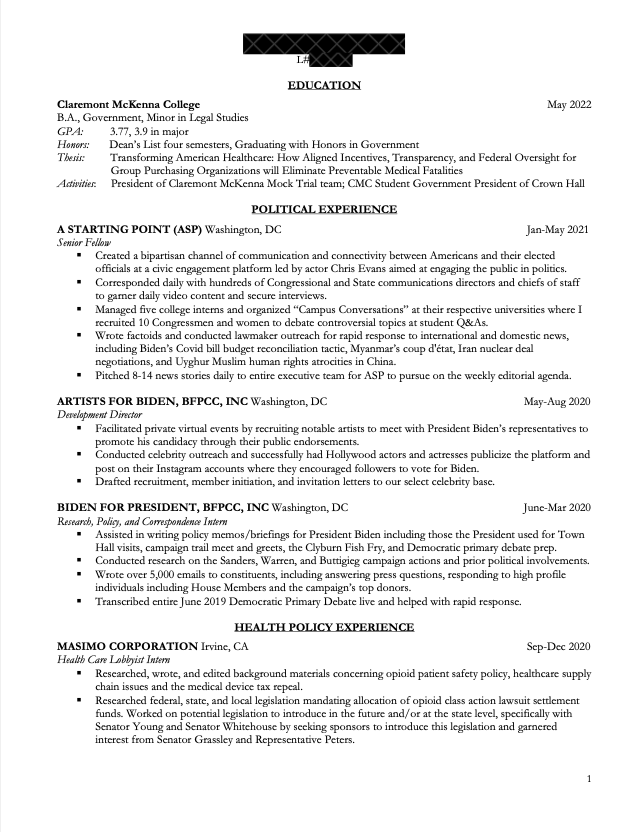
Example 1: The college senior with a lot of experience
Education
- GPA: 3.77, 3.9 in major
- Honors: Dean’s List four semesters, Graduating with Honors in Government
- Thesis: Transforming American Healthcare: How Aligned Incentives, Transparency, and Federal Oversight for Group Purchasing Organizations will Eliminate Preventable Medical Fatalities
- Activities: President of Claremont McKenna Mock Trial team; CMC Student Government President of Crown Hall
Political Experience
- Created a bipartisan channel of communication and connectivity between Americans and their elected officials at a civic engagement platform led by actor Chris Evans aimed at engaging the public in politics.
- Corresponded daily with hundreds of Congressional and State communications directors and chiefs of staff to garner daily video content and secure interviews.
- Managed five college interns and organized “Campus Conversations” at their respective universities where I recruited 10 Congressmen and women to debate controversial topics at student Q&As.
- Wrote factoids and conducted lawmaker outreach for rapid response to international and domestic news, including Biden’s Covid bill budget reconciliation tactic, Myanmar’s coup d’état, Iran nuclear deal negotiations, and Uyghur Muslim human rights atrocities in China.
- Pitched 8-14 news stories daily to entire executive team for ASP to pursue on the weekly editorial agenda.
- Facilitated private virtual events by recruiting notable artists to meet with President Biden’s representatives to promote his candidacy through their public endorsements.
- Conducted celebrity outreach and successfully had Hollywood actors and actresses publicize the platform and post on their Instagram accounts where they encouraged followers to vote for Biden.
- Drafted recruitment, member initiation, and invitation letters to our select celebrity base.
- Assisted in writing policy memos/briefings for President Biden including those the President used for Town Hall visits, campaign trail meet and greets, the Clyburn Fish Fry, and Democratic primary debate prep.
- Conducted research on the Sanders, Warren, and Buttigieg campaign actions and prior political involvements.
- Wrote over 5,000 emails to constituents, including answering press questions, responding to high profile individuals including House Members and the campaign’s top donors.
- Transcribed entire June 2019 Democratic Primary Debate live and helped with rapid response.
Health Policy Experience
- Researched, wrote, and edited background materials concerning opioid patient safety policy, healthcare supply chain issues and the medical device tax repeal.
- Researched federal, state, and local legislation mandating allocation of opioid class action lawsuit settlement funds. Worked on potential legislation to introduce in the future and/or at the state level, specifically with Senator Young and Senator Whitehouse by seeking sponsors to introduce this legislation and garnered interest from Senator Grassley and Representative Peters.
- Participated and transcribed for team at political events/meetings in support of projects, including with White House staff in Domestic Policy Council, National Economic Council, and White House Legislative Affairs.
- Spearheaded research on cognitive advances and authored an article about eradicating pain using noninvasive brain therapies such as VR, visualization, and pets (published in Digital Health Magazine).
- Wrote bios for 9,000 digital health transformer companies and founders for the Startup Health database – Air Table. Scouted for new potential companies in whom to invest.
- Helped organize two 500 person summits centered on the latest developments in patent law for medical device companies.
- Wrote attorney biographies, cleaned up typos and incorrect case citations, and fixed dead links on website to improve web presence.
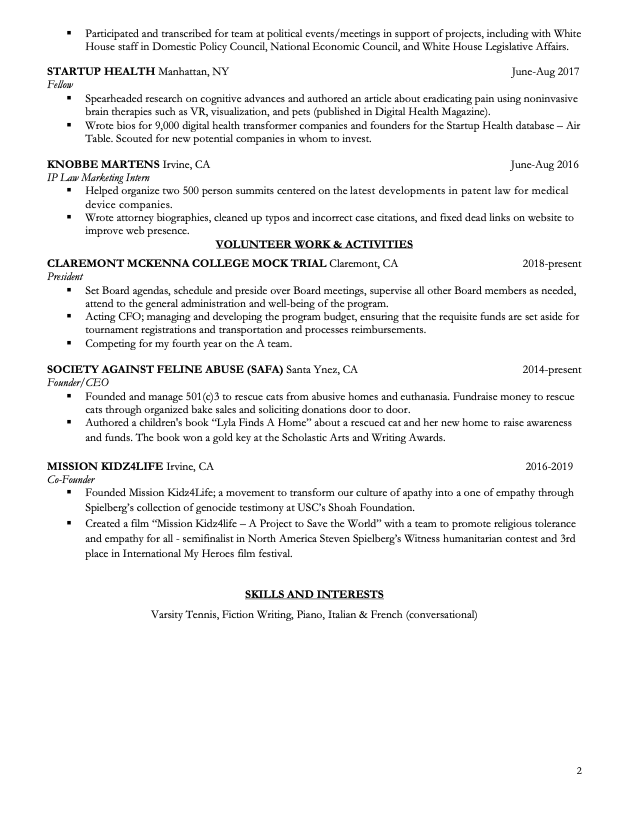
Volunteer Work & Activities
- Set Board agendas, schedule and preside over Board meetings, supervise all other Board members as needed, attend to the general administration and well-being of the program.
- Acting CFO; managing and developing the program budget, ensuring that the requisite funds are set aside for tournament registrations and transportation and processes reimbursements.
- Competing for my fourth year on the A team.
- Founded and manage 501(c)3 to rescue cats from abusive homes and euthanasia. Fundraise money to rescue cats through organized bake sales and soliciting donations door to door.
- Authored a children’s book “Lyla Finds A Home” about a rescued cat and her new home to raise awareness and funds. The book won a gold key at the Scholastic Arts and Writing Awards.
- Founded Mission Kidz4Life; a movement to transform our culture of apathy into a one of empathy through Spielberg’s collection of genocide testimony at USC’s Shoah Foundation.
- Created a film “Mission Kidz4life – A Project to Save the World” with a team to promote religious tolerance and empathy for all – semifinalist in North America Steven Spielberg’s Witness humanitarian contest and 3rd place in International My Heroes film festival.
Skills and Interests
Varsity Tennis, Fiction Writing, Piano, Italian & French (conversational)
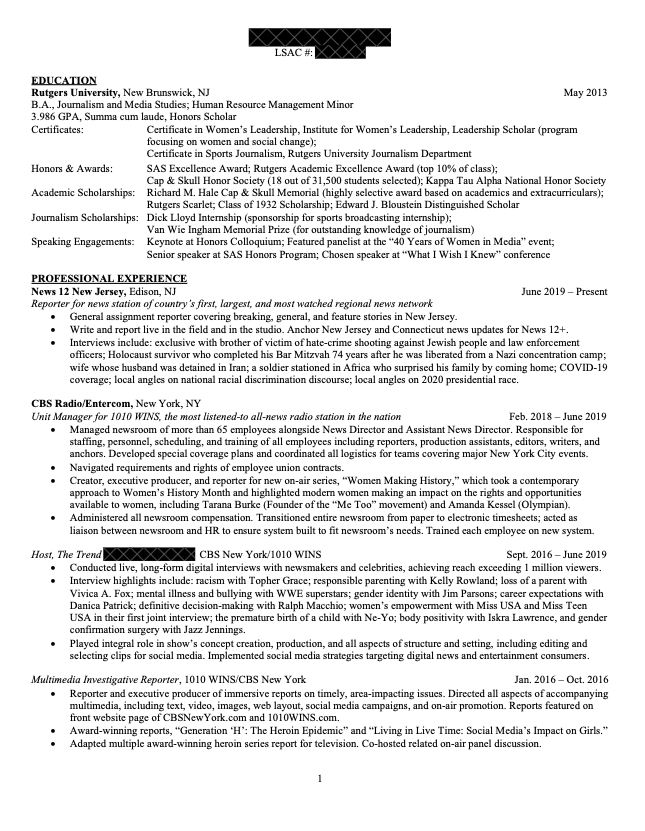
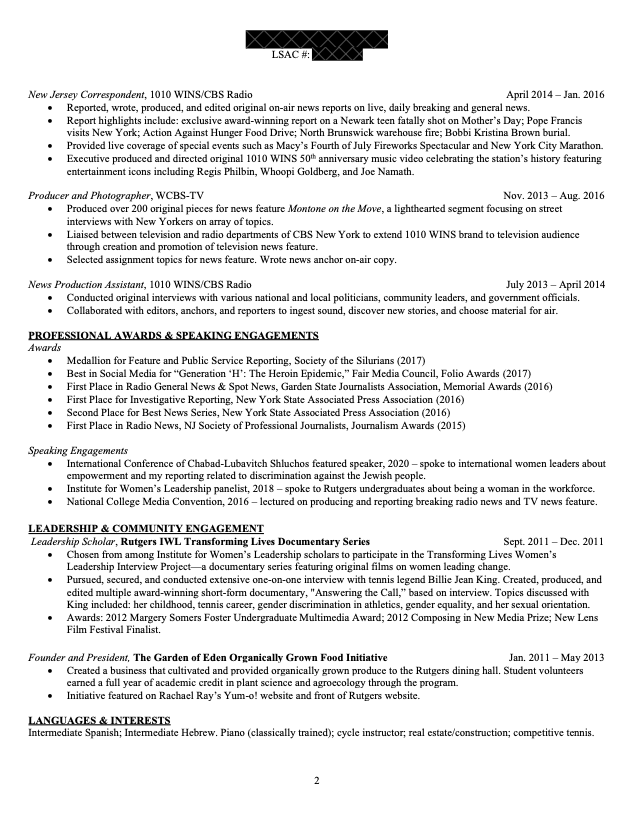
Example 2: The applicant with over a decade of professional experience
Education
- Certificates: Certificate in Women’s Leadership, Institute for Women’s Leadership, Leadership Scholar (program focusing on women and social change); Certificate in Sports Journalism, Rutgers University Journalism Department
- Honors & Awards: SAS Excellence Award; Rutgers Academic Excellence Award (top 10% of class); Cap & Skull Honor Society (18 out of 31,500 students selected); Kappa Tau Alpha National Honor Society
- Academic Scholarships: Richard M. Hale Cap & Skull Memorial (highly selective award based on academics and extracurriculars); Rutgers Scarlet; Class of 1932 Scholarship; Edward J. Bloustein Distinguished Scholar
- Journalism Scholarships: Dick Lloyd Internship (sponsorship for sports broadcasting internship); Van Wie Ingham Memorial Prize (for outstanding knowledge of journalism)
- Speaking Engagements: Keynote at Honors Colloquium; Featured panelist at the “40 Years of Women in Media” event; Senior speaker at SAS Honors Program; Chosen speaker at “What I Wish I Knew” conference
Professional Experience
- General assignment reporter covering breaking, general, and feature stories in New Jersey.
- Write and report live in the field and in the studio. Anchor New Jersey and Connecticut news updates for News 12+.
- Interviews include: exclusive with brother of victim of hate-crime shooting against Jewish people and law enforcement officers; Holocaust survivor who completed his Bar Mitzvah 74 years after he was liberated from a Nazi concentration camp; wife whose husband was detained in Iran; a soldier stationed in Africa who surprised his family by coming home; COVID-19 coverage; local angles on national racial discrimination discourse; local angles on 2020 presidential race.
- Managed newsroom of more than 65 employees alongside News Director and Assistant News Director. Responsible for staffing, personnel, scheduling, and training of all employees including reporters, production assistants, editors, writers, and anchors. Developed special coverage plans and coordinated all logistics for teams covering major New York City events.
- Navigated requirements and rights of employee union contracts.
- Creator, executive producer, and reporter for new on-air series, “Women Making History,” which took a contemporary approach to Women’s History Month and highlighted modern women making an impact on the rights and opportunities available to women, including Tarana Burke (Founder of the “Me Too” movement) and Amanda Kessel (Olympian).
- Administered all newsroom compensation. Transitioned entire newsroom from paper to electronic timesheets; acted as liaison between newsroom and HR to ensure system built to fit newsroom’s needs. Trained each employee on new system.
- Conducted live, long-form digital interviews with newsmakers and celebrities, achieving reach exceeding 1 million viewers.
- Interview highlights include: racism with Topher Grace; responsible parenting with Kelly Rowland; loss of a parent with Vivica A. Fox; mental illness and bullying with WWE superstars; gender identity with Jim Parsons; career expectations with Danica Patrick; definitive decision-making with Ralph Macchio; women’s empowerment with Miss USA and Miss Teen USA in their first joint interview; the premature birth of a child with Ne-Yo; body positivity with Iskra Lawrence, and gender confirmation surgery with Jazz Jennings.
- Played integral role in show’s concept creation, production, and all aspects of structure and setting, including editing and selecting clips for social media. Implemented social media strategies targeting digital news and entertainment consumers.
- Reporter and executive producer of immersive reports on timely, area-impacting issues. Directed all aspects of accompanying multimedia, including text, video, images, web layout, social media campaigns, and on-air promotion. Reports featured on front website page of CBSNewYork.com and 1010WINS.com.
- Award-winning reports, “Generation ‘H’: The Heroin Epidemic” and “Living in Live Time: Social Media’s Impact on Girls.”
- Adapted multiple award-winning heroin series report for television. Co-hosted related on-air panel discussion.
- Reported, wrote, produced, and edited original on-air news reports on live, daily breaking and general news.
- Report highlights include: exclusive award-winning report on a Newark teen fatally shot on Mother’s Day; Pope Francis visits New York; Action Against Hunger Food Drive; North Brunswick warehouse fire; Bobbi Kristina Brown burial.
- Provided live coverage of special events such as Macy’s Fourth of July Fireworks Spectacular and New York City Marathon.
- Executive produced and directed original 1010 WINS 50th anniversary music video celebrating the station’s history featuring entertainment icons including Regis Philbin, Whoopi Goldberg, and Joe Namath.
- Produced over 200 original pieces for news feature Montone on the Move, a lighthearted segment focusing on street interviews with New Yorkers on array of topics.
- Liaised between television and radio departments of CBS New York to extend 1010 WINS brand to television audience through creation and promotion of television news feature.
- Selected assignment topics for news feature. Wrote news anchor on-air copy.
- Conducted original interviews with various national and local politicians, community leaders, and government officials.
- Collaborated with editors, anchors, and reporters to ingest sound, discover new stories, and choose material for air.
Professional Awards & Speaking Engagements
- Medallion for Feature and Public Service Reporting, Society of the Silurians (2017)
- Best in Social Media for “Generation ‘H’: The Heroin Epidemic,” Fair Media Council, Folio Awards (2017)
- First Place in Radio General News & Spot News, Garden State Journalists Association, Memorial Awards (2016)
- First Place for Investigative Reporting, New York State Associated Press Association (2016)
- Second Place for Best News Series, New York State Associated Press Association (2016)
- First Place in Radio News, NJ Society of Professional Journalists, Journalism Awards (2015)
- International Conference of Chabad-Lubavitch Shluchos featured speaker, 2020 – spoke to international women leaders about empowerment and my reporting related to discrimination against the Jewish people.
- Institute for Women’s Leadership panelist, 2018 – spoke to Rutgers undergraduates about being a woman in the workforce.
- National College Media Convention, 2016 – lectured on producing and reporting breaking radio news and TV news feature.
Leadership & Community Engagement
- Chosen from among Institute for Women’s Leadership scholars to participate in the Transforming Lives Women’s Leadership Interview Project—a documentary series featuring original films on women leading change.
- Pursued, secured, and conducted extensive one-on-one interview with tennis legend Billie Jean King. Created, produced, and edited multiple award-winning short-form documentary, “Answering the Call,” based on interview. Topics discussed with King included: her childhood, tennis career, gender discrimination in athletics, gender equality, and her sexual orientation.
- Awards: 2012 Margery Somers Foster Undergraduate Multimedia Award; 2012 Composing in New Media Prize; New Lens Film Festival Finalist.
- Created a business that cultivated and provided organically grown produce to the Rutgers dining hall. Student volunteers earned a full year of academic credit in plant science and agroecology through the program.
- Initiative featured on Rachael Ray’s Yum-o! website and front of Rutgers website.
Languages & Interests
Intermediate Spanish; Intermediate Hebrew. Piano (classically trained); cycle instructor; real estate/construction; competitive tennis.
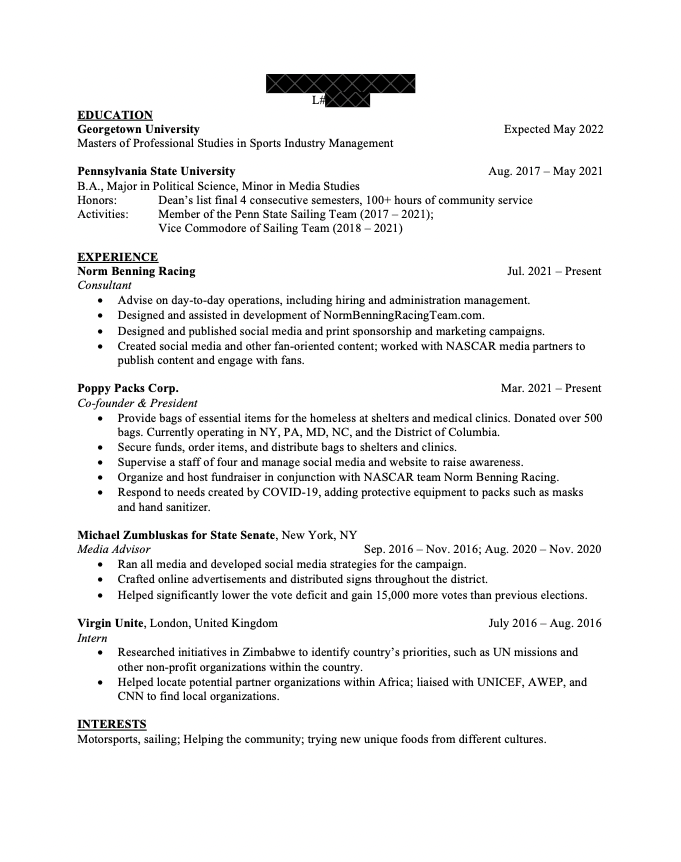
Example 3: The college senior with minimal experience
Skills and interests on a law school resume
Keep skills and interests to one or two lines in a single section. List languages with your proficiency level and any specialized abilities, skip skills every applicant has, and make your interests specific.
- Skills: Include things like language fluency (and your level of competency), musical abilities, and computer languages. Don’t include what most other applicants can do, like Microsoft Office, social media, or ChatGPT. Every law school applicant can use Word, Excel, and PowerPoint, and every one of them can type. You don’t need to tell law schools.
- Interests: Make these very specific. Don’t just say general (cough, boring) interests like “reading, traveling, cooking.” What specific kinds of books do you read? What do you cook? “Regional Italian cooking” says far more about you than “cooking.”
Your interests should be ones you consider significant. It’s also okay to show a specific religious or political affiliation. Think about the things that make you unique, memorable, and likable, and include those.
On that note, what skills are law schools looking for? Watch my short video where I share the exact skills law schools value:
Law school resume for non-traditional applicants
If you’re a career changer, you’ve been working for years, or your background doesn’t fit the usual mold, organize your resume by theme or career, explain your work in plain language, and account for your time.
Applying after years in the workforce? You’re not at a disadvantage. But your resume needs to do a bit more work. Here’s how:
Career changers: Divide by career, not time
If you’ve had more than one main career, divide your headers by career topic instead of going strictly chronological. A former educator who moved into science might use “Teaching Experience” and “Biotechnology Experience.” Within each header, keep entries in reverse chronological order.
Translate technical work into plain language
Your reader may not share your background.
One client with five years of laboratory experience struggled because his resume was dense with technical methods. We reframed his bullets from obscure lab processes to high-level execution: “Planned, led and executed studies across multiple boundaries; worked with external vendors… and evaluated results and synthesized relevant reports.” Now any admissions officer can tell what he did and how much responsibility he carried.
Make a pivot look deliberate
To an admissions officer, a move into law can look random if your resume is a list of generic tasks. One client, an engineer headed for patent law, listed ordinary engineering tasks at first. We zoomed in on his specific technical responsibilities and patent-adjacent research, so the move into law read as a clear next step.
Don’t hide unglamorous work
Not every applicant has fancy internships. One client had a sparse resume, but he’d worked 90 hours a week managing a family franchise pizza restaurant while attending college. Reframing that entry around operations, staff management and leadership turned what looked like a small detail into the strongest line on the page.
Handle a scattered work history
If your work experience seems to be all over the place, group it. Put internships and career-related roles under “Professional Experience,” and your summer jobs or during-college gigs under “Other Employment.” Generally you’ll still want to include most jobs to account for your time. If some older jobs truly don’t fit your field or your narrative, you can leave them off, as long as your timeline doesn’t have confusing gaps.
If you’ve been at one job for a long time
A single, long-term role doesn’t force you into two pages. If you’ve been at the same job for the past decade, one page is fine.
What mistakes should you avoid on your law school resume?
The most common mistakes are including high school, copying a job-hunt format, listing skills everyone has, using jargon, embellishing, and shrinking the page to fit.
What are the top mistakes to avoid? Let’s find out:
- High school. Law schools don’t care about it. You’re applying for a professional degree, and they want to see you can thrive without the support of your parents or high school teachers.
- An objective, summary or relevant coursework. These belong on job-hunt resumes, not law school resumes.
- Skills every applicant has. Word, Excel, PowerPoint, and typing don’t set you apart.
- Jargon and unclear acronyms. No matter an admissions officer’s background, they should know what you’re talking about.
- Embellishment. Any embellishment sets off an admissions officer’s alarm bells and undermines your entire application. If you did something above and beyond, include it. But don’t make your filing work as a front desk associate sound like you were the one drafting the files.
- Tiny fonts and margins. Keep your font at 11 pt or larger, and be more concise instead of squeezing the page.
- A GPA below the school’s median. If it’s low, leave it off.
- Exaggerating thin volunteer work. It only draws attention to what you don’t have.
How to build the rest of your application
There you have it! You now know how to create a law school resume: lead with education, show what you did instead of what your employer does, keep it to one or two pages, and don’t let anything on it be anything less than true.
It comes down to using your resume as an opportunity to build on your application and stand out from the masses.
But once you’ve nailed your resume, you’ll still need We’ve already talked about personal statements; for the other parts, read my guides here:
- Who and how to ask for letters of recommendation
- How and when to write law school addenda
- Should you write a statement of perspective?
And if you want a curated strategy from the start, even if you don’t have the perfect GPA, LSAT score, or resume, I help law school applicants with different backgrounds get accepted by their dream schools. Read more about working with me here.